Ralph Tyler
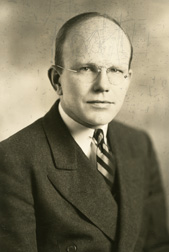
Ralph Tyler was an American educator who worked in the field of assessment and evaluation.Tyler made a name for himself at Ohio State University by showing the faculty how to generate evidence that spoke to their course objectives. Tyler first coined the term "evaluation" as it pertained to school; in describing a testing construct that moved away from pencil and paper memorization examinations and toward an evidence collection process dedicated to overarching teaching and learning objectives. He insisted on looking at evaluation as a matter of evidence.Tyler's reputation as an education expert grew with the publication of Basic Principles of Curriculum and Instruction. Tyler headed the evaluation staff of the "Eight-Year Study" (1933–1941), a national program, involving 30 secondary schools and 300 colleges and universities, that addressed narrowness and rigidity in high school curricula.
Ralph Tyler developed the Tyler Model in the 1940’s. It is the prototype of curriculum development in the scientific approach. One could say that every certified teacher in America and maybe beyond has developed curriculum either directly or indirectly using this model or one of the many variations. Tyler did not intend for his contribution to curriculum to be a lockstep model for development. Originally, he wrote down his ideas in a book Basic Principles of Curriculum and Instruction for his students to give them an idea about principles for to making curriculum.Ralph W. Tyler presented the concept that curriculum should be dynamic, a program under constant evaluation and revision. Curriculum had earlier been thought of as a static, set program, and in an era preoccupied with student testing, he offered the innovative idea that teachers and administrators should spend as much time evaluating their plans as they do assessing their students.
Tyler’s model was one of the first models and it is a highly simple model consisting of four steps
1. Determine the school’s purposes (objectives)
2. Identify educational experiences related to the purpose
3. Organize the experiences
4. Evaluate the purposes
Step one is determining the objectives of the school or class. In other words, what do the students need to do in order to be successful? Each subject has natural objectives that are indicators of mastery. All objectives need to be consistent with the philosophy of the school and this is often neglected in curriculum development. For example, a school that is developing an English curriculum may create an objective that students will write essays throughout the school year. This would be one of many objectives within the curriculum.
Step two is about developing learning experiences that help the students to achieve the objective, (step 1). For example, if students need to meet the objective of writing an essay. The learning experience might be the teacher demonstrating how to write an essay. Then the students would practice writing essays. The experience (essay demonstration and writing) is consistent with the objective (Student will write an essay).
Step three is organizing the experiences. Which way will the teacher introduce writing an essay? Should the teacher demonstrate first or should the students learn by writing immediately? Either way could work and preference is determined by the philosophy of the teacher and the needs of the students. The teacher needs to determine a logical order of experiences for the students to complete the objective.
Lastly, step four is the evaluation of the objectives. Now the teacher assesses the student’s ability to write an essay. There are many ways to do this. For example, the teacher could have the students write an essay without assistance. If they can do this, it is evidence that the students have achieved the objective of the lesson.
Tyler believed that the structure of the school curriculum also had to be responsive to three central factors that represent the main elements of an educative experience:
1) The nature of the learner (developmental factors, learner interests and needs, life experiences, etc.)
(2) The values and aims of society (democratizing principles, values and attitudes)
(3) Knowledge of subject matter (what is believed to be worthy and usable knowledge)
In answering the four questions and in designing school experience for children, curriculum developers had to screen their judgments through the three factors.
The behavioral approach to curriculum has evolved over the years to address the complexities of human learning and it has allowed for research that investigates the depths of the mind. Most educators realize that to obtain a more complete picture of how individuals learn the curriculum; they as must perceive individuals as cognitive functioning individuals within social context. There have been arguments that students will experience and respond to the curriculum in unique ways, depending on their cultural interpretations and prior life activities.
Edgar Dale
Edgar Dale was an American educationist who developed the Cone of Experience. He made several contributions to audio and visual instruction, including a methodology for analyzing the content of motion pictures.
Dale’s Cone of Experience is a model that incorporates several theories related to instructional design and learning processes. During the 1960s, Edgar Dale theorized that learners retain more information by what they “do” as opposed to what is “heard”, “read” or “observed”. His research led to the development of the Cone of Experience. The Cone was originally developed in 1946 and was intended as a way to describe various learning experiences. Essentially, the Cone shows the progression of experiences from the most concrete (at the bottom of the cone) to the most abstract (at the top of the cone).
Dale’s Cone of Experience is a model that incorporates several theories related to instructional design and learning processes. According to Dale, the arrangement in the cone is not based on its difficulty but rather based on abstraction, and on the number of senses involved. The experiences in each stages can be mixed and are interrelated that fosters meaningful learning. This “learning by doing” has become known as “experiential learning” or “action learning.


